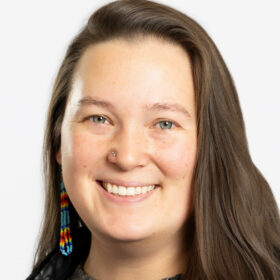
Meet Janelle:
My name is Janelle Sharp, Uvaŋa Anausuk, and I was born and raised in Anchorage, Alaska. My mom is Suzanne Sharp, formerly Mendenhall, from Kotzebue, Alaska, and my dad is Timothy Sharp from Jefferson City, Missouri. I’m working on my Ph.D. in Earth System Science with an emphasis on geochemistry through the University of Alaska Fairbanks. Academically, my project focuses on geochemical systems that exist at a remote Arctic mine site in Alaska. I’m investigating how certain weathered rocks interact with the water and soil systems within the mine site. Currently, I’m also working as a geoscientist/geochemist for NANA Regional Corporation, and my academic work is helping me to advance that career in the field of natural resources. In addition to the sciences, I’m passionate about seeing young Alaska Native students advance in STEM fields, and have been an intern mentor, partner, and project collaborator for STEM-focused programs in Alaska.
I was introduced to the Caleb Scholars Program by a college mentor, and when I read through the mission, vision, and values, they very much align with those of my own personal and professional development. I’ve worked in environmental remediation for 16 years, and have worked on and off with the Alaska Native Science and Engineering Program for 6 years. My path of environmental remediation and responsible resource development has been shaped by career development with ANSEP, whose mission is to develop the next generation of Alaska Native leaders because we have a genuine desire to preserve our ways of life and subsistence. We also need the power of education in order to guide future responsible development and resource use for our communities, people within our region, and, on a broader scale, our state. I find that this same mission aligns with the Caleb Scholars Program, and that makes me very proud to be a recipient.
What does Inuit-led conservation advocacy mean to you? How will your education and degree program prepare you to contribute to this work?
To me, Inuit-led conservation advocacy means ensuring that decisions about our lands, waters, and resources are guided by the people who have lived with them, depended on them, and will continue to steward them for future generations. It means having the technical expertise within our own communities to independently evaluate environmental impacts, advocate for responsible development, and ensure that conservation reflects both Indigenous knowledge and sound science. This purpose is the reason I chose to work as a geochemist for my Alaska Native corporation while pursuing a Ph.D. in geochemistry.
As resource development and mine closure become increasingly important across our region, I believe Inuit organizations need to have internal experts who understand the science well enough to ask difficult questions, challenge assumptions, and make informed decisions that protect both our people and our environment. My doctoral research focuses on the geochemistry of mine waste and closure planning at an Arctic mine. By studying how mine waste behaves over time and identifying approaches for responsible closure, I am building expertise that will help ensure our lands remain safe for future subsistence activities while supporting responsible resource development where it aligns with our communities’ values. My goal is to serve as a bridge between science, industry, and our communities. I am able to use my advanced technical knowledge to advocate for solutions that protect our environment, strengthen Indigenous self-determination, and ensure Inuit voices remain at the center of conservation decisions.